


Research Security Realities and How to Overcome Them
Every year, our adversaries inflict hundreds of billions of dollars of economic damage to U.S. institutions and corporations. They do it by unlawfully accessing academic and corporate research to steal American innovation, disrupt supply chains, commit economic espionage, execute malign foreign talent recruitment programs, infiltrate networks and infect our investment capital across all industries – especially in the areas of critical infrastructure and emerging technologies.
The current set of tools available to research security professionals is fragmented. There are multiple players in multiple capability spaces and very few offering a comprehensive suite of capabilities that truly serve to secure the innovation enterprise. The problem is simply too big, and the stakes are too high to get one piece of the puzzle right.
Today’s research security professionals would be wise to consider the broad set of capabilities they need and to examine the vendors who can reliably and comprehensibly provide them and who can continually evolve their offerings as both the threat landscape and the technology landscape evolve. As we see it, the current operating reality for research security officers (RSOs) looks like this:
Fragmentation is the core operational problem. In this environment, RSOs are forced to “tool-chain” their workflow. In practice, this means research security teams must jump across disconnected products and manual steps to assemble identity, affiliation, collaboration, funding, and risk context. This drives inconsistent decision making, creates longer cycle times, and persists preventable and avoidable blind spots.
The market is shifting from point tools to workflow platforms that unify data provenance. What RSOs increasingly need is not another single-purpose dataset, but a platform that consolidates and preserves provenance across various data sources. This allows them to make defensible and risk-based decisions and determinations so that every assessment is traceable, reproducible, and audit-ready.
Platforms must be built around the RSO workflow and fuse the right categories of end-to-end data. In recognition of this need, our work at Finch AI does not rely on a singular data source. Instead, we integrate the domains that RSOs actually depend on, including corporate data (ownership, subsidiaries, control), academic and research data (affiliations, publications, collaborations), threat-country-specific data (state-linked entities, priority sectors, and other contextual signals). Then, we bring them together into one operational environment.
AI is an accelerator enabling faster quantitative and qualitative risk evaluation. With consolidated data and provenance as the foundation, Finch AI applies AI to expedite both quantitative analysis (entity resolution, network relationships, change detection) and qualitative synthesis (contextual narratives, evidence-based summaries) to support consistent, defensible decisions at scale.
With this important context in mind, RSOs must have mission partners who not only understand the current research security landscape, but who can help them navigate challenges and thrive. In our work as part of the National Science Foundation’s SECURE Analytics partnership, we do precisely that. Together, we are building a next-generation research security platform that meets the moment with fit-for-purpose capabilities that secure the innovation enterprise and protect American national and economic security.
To learn more about what we’re doing and how we might partner to apply these same principles to your mission, please get in touch at info@finchai.com.
###
Share
Eric Schweser, Director, Counterintelligence & Research Security Solutions
Discover More
Research Security Reflections: Building Capacity and Capability
Capacity and capability continue to be the focus of most conversations I’m having with research security practitioners. In the tactical research security (RS) sense,…

Secure, Trusted, Easy to Procure AI is Needed Now More Than Ever
Last week, I attended the Potomac Officers Club’s 2026 Intel Summit. For one afternoon, dozens of intelligence leaders, mission partners and technologists gathered to…

Research Security in the Gray: Navigating (and Shortening) the Gap Between Identifying a Risk and Addressing It
As a community, those of us working in research security know what failures look like. A failure is well defined. What is less clear is…

Finch AI Selected to Deliver Critical Supply Chain Risk Insights to the U.S. Air Force
STTR Phase I Contract Focuses on Detecting Foreign Influence within the U.S. Industrial Base Found On PR Newswire (Herndon, VA) – Finch AI announces…

Ask Finch. Know Faster. Know for Sure.
On the surface, the job of an intelligence analyst, a corporate due diligence professional, a research security officer and a fraud detection specialist seem…
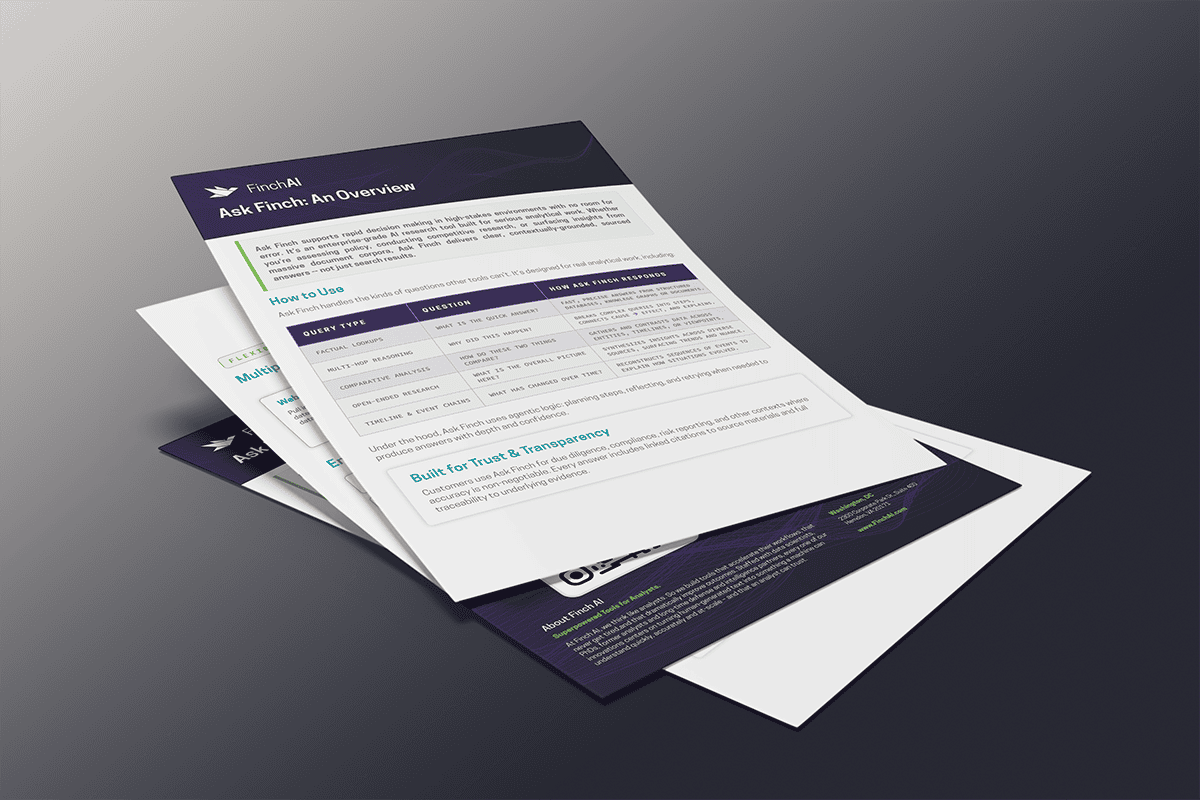
Ask Finch: An Overview
Your Average AI Tool Can Search, But How Well Can it Reason?Ask Finch handles the kinds of questions other tools can't. It's designed for…
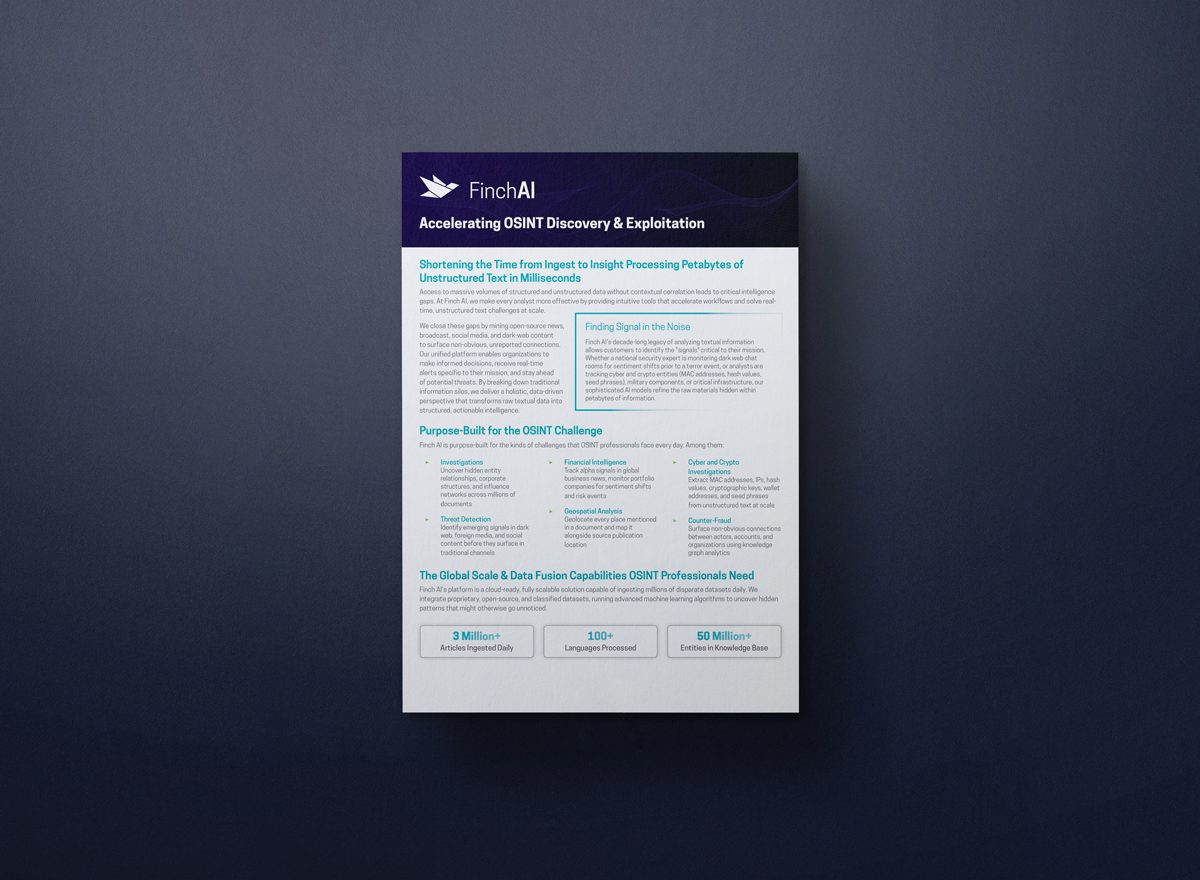
Accelerating OSINT Discovery & Exploitation
Finding Signal in the Noise OSINT professionals face an insurmountable of unstructured data daily–from news, to broadcast, social media, dark web content and more.…
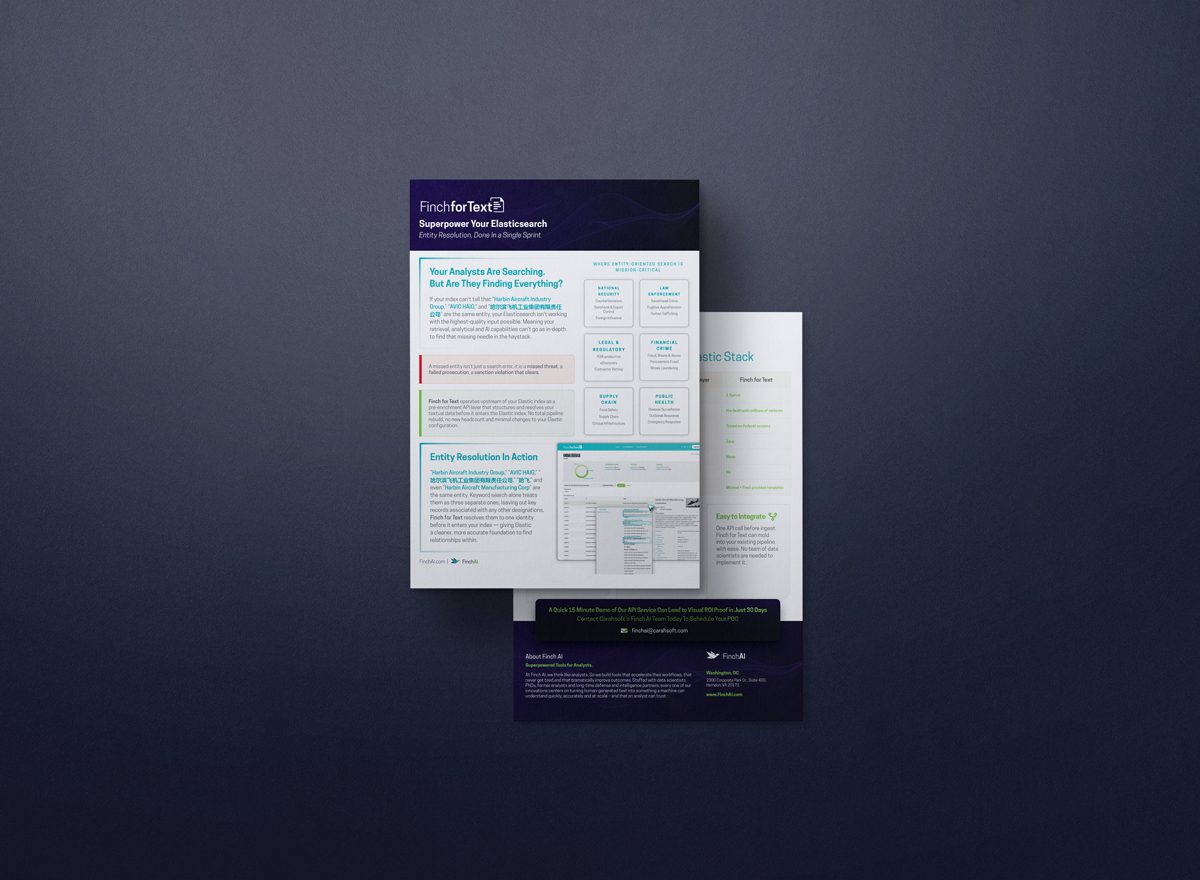
Superpower Your Elasticsearch: Entity Resolution, Done In a Single Sprint
Your Analysts Are Searching, But Are They Finding Everything? A missed entity isn't just a trivial search error – it is a missed threat.…